


 SPARK Website
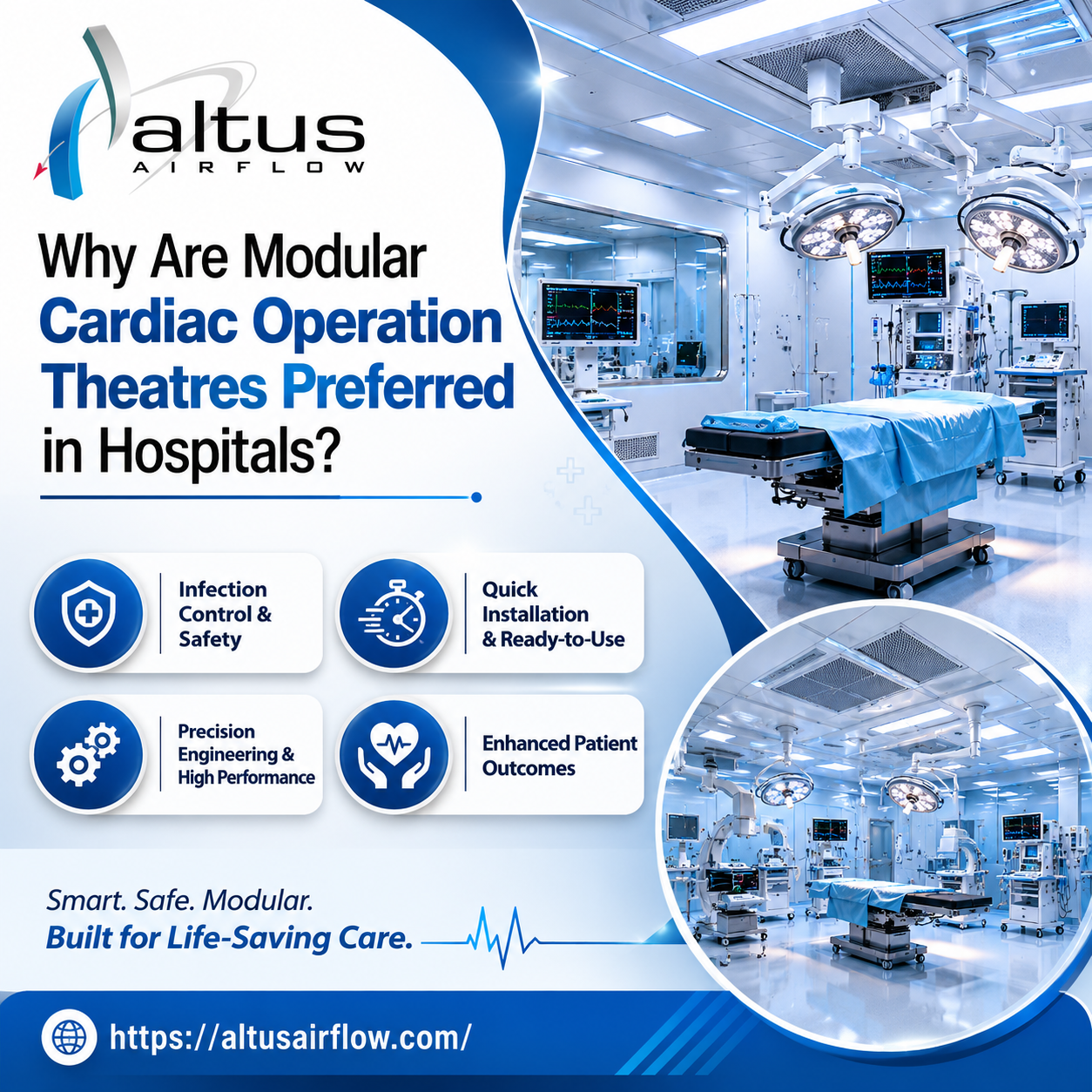
Why Are Modular Cardiac Operation Theatres Preferred in Hospitals?
Introduction
The healthcare industry has witnessed major technological advancements in surgical infrastructure over the last decade. Hospitals today require highly specialized operation theatres capable of supporting complex procedures while maintaining strict infection-control standards and operational efficiency. Among the most advanced surgical environments, the Modular Cardiac Operation Theatre has become the preferred choice for hospitals because of its superior contamination control, advanced engineering systems, faster installation, and long-term operational benefits. Healthcare solution providers like Altus Airflow help hospitals establish modern cardiac operation theatres equipped with sophisticated HVAC systems, laminar airflow technologies, HEPA filtration, modular wall systems, and cleanroom engineering infrastructure.
Cardiac surgeries are among the most sensitive medical procedures and require stable environmental conditions, contamination-free airflow, reliable electrical systems, and highly efficient workflow management. Traditional operation theatres often struggle to meet the increasing technological and safety demands of modern cardiac procedures. Modular cardiac OTs solve these challenges through integrated engineering solutions and advanced medical infrastructure.
Understanding a Modular Cardiac Operation Theatre
A Modular Cardiac Operation Theatre is a pre-engineered surgical environment designed using advanced modular construction methods and integrated healthcare engineering systems.
These operation theatres typically include:
- HVAC systems
- Laminar airflow technology
- HEPA filtration
- Modular wall systems
- Medical gas systems
- OT automation
- Environmental monitoring systems
The objective is to create sterile, efficient, and technologically advanced surgical spaces.
Better Infection Control
One of the main reasons hospitals prefer modular cardiac OTs is superior infection prevention.
These operation theatres use advanced contamination-control technologies such as:
- HEPA filtration
- Laminar airflow systems
- Positive pressure environments
- Antibacterial surfaces
Improved infection control enhances patient safety during cardiac surgeries.
Advanced HVAC Systems
HVAC systems are critical in cardiac operation theatres.
Modern modular OTs use specialized HVAC systems that maintain:
- Sterile airflow
- Controlled temperature
- Balanced humidity
- Positive pressure conditions
Proper HVAC engineering improves environmental stability and surgical safety.
Importance of Laminar Airflow
Laminar airflow systems provide uniform filtered airflow over the surgical area.
Benefits include:
- Reduced airborne contamination
- Stable airflow patterns
- Cleaner surgical zones
Laminar airflow plays a major role in maintaining sterile conditions.
HEPA Filtration Benefits
HEPA filters remove microscopic airborne particles from the OT environment.
These filters help eliminate:
- Dust particles
- Bacteria
- Airborne pathogens
- Fungal spores
HEPA filtration improves air quality and contamination prevention.
Faster Construction and Installation
Hospitals prefer modular operation theatres because they can be installed faster than traditional OTs.
Modular systems use:
- Prefabricated components
- Pre-engineered panels
- Faster assembly methods
Quick installation reduces construction downtime and operational disruption.
Reduced Hospital Disruption
Traditional OT construction often creates noise, dust, and workflow interruptions.
Modular construction minimizes:
- Construction debris
- Operational disturbance
- Installation delays
Hospitals can continue functioning more efficiently during project execution.
Better Workflow Management
Modern cardiac OTs are designed to improve workflow efficiency.
Features include:
- Organized equipment placement
- Better staff movement
- Optimized surgical layouts
Improved workflow enhances surgical coordination and productivity.
Easy Maintenance
Modular cardiac operation theatres are easier to maintain compared to traditional OTs.
Benefits include:
- Replaceable panels
- Easier cleaning
- Simplified repairs
- Lower maintenance downtime
Efficient maintenance improves long-term operational reliability.
Hygienic Wall Systems
A Modular Cardiac Operation Theatre uses specialized wall panels made from healthcare-grade materials such as:
- Stainless steel
- High-pressure laminates
- Powder-coated galvanized steel
These surfaces are:
- Antibacterial
- Non-porous
- Easy to sanitize
Hygienic wall systems improve contamination control.
Seamless Flooring Systems
Modular cardiac OTs use seamless flooring systems designed for healthcare environments.
Advantages include:
- Chemical resistance
- Easy cleaning
- Slip resistance
- Reduced microbial accumulation
Seamless flooring improves hygiene and safety.
Advanced Electrical Infrastructure
Cardiac surgeries require stable electrical systems for sensitive medical equipment.
Modern modular OTs include:
- UPS backup systems
- Isolated power systems
- Generator integration
- Circuit protection systems
Reliable electrical infrastructure reduces operational risks.
Integrated Medical Gas Systems
Medical gas infrastructure is an essential component of modern cardiac OTs.
These systems support:
- Oxygen supply
- Vacuum systems
- Compressed air
- Nitrous oxide
Integrated systems improve accessibility and surgical support.
OT Automation Systems
Automation technologies improve environmental management and operational efficiency.
Automation systems control:
- HVAC systems
- Lighting
- Temperature
- Humidity
- Pressure balance
Centralized controls simplify OT management.
Environmental Monitoring Systems
Continuous environmental monitoring improves operational consistency.
Monitoring systems track:
- Air quality
- Humidity
- Temperature
- Pressure levels
Real-time monitoring helps maintain stable surgical conditions.
Support for Advanced Surgical Technologies
Modern cardiac surgeries increasingly rely on advanced medical technologies such as:
- Robotic surgery systems
- HD imaging systems
- Digital monitoring equipment
Modular OTs are designed to support these technologies efficiently.
Better Air Quality Management
Air quality management is essential during cardiac procedures.
Modular OTs maintain:
- Controlled airflow
- Sterile ventilation
- Reduced airborne contamination
Improved air quality enhances surgical safety.
Positive Pressure Environment
Positive pressure systems prevent contaminated external air from entering the OT.
Benefits include:
- Cleaner surgical spaces
- Better contamination prevention
- Improved environmental stability
Positive pressure systems support sterile conditions.
Compliance With Healthcare Standards
Modular cardiac OTs are designed to comply with strict healthcare regulations related to:
- Air quality
- Electrical safety
- Fire safety
- Infection control
Compliance improves operational safety and accreditation readiness.
Improved Patient Safety
Hospitals prioritize modular OTs because they improve patient outcomes through:
- Reduced infection risks
- Stable surgical environments
- Better contamination control
Patient safety is one of the biggest advantages of modular systems.
Energy Efficiency
Modern modular OTs use energy-efficient technologies such as:
- Smart HVAC systems
- LED lighting
- Automated controls
Energy-efficient systems help reduce operational costs.
Future Scalability
Hospitals prefer modular infrastructure because it supports future expansion and upgrades.
Advantages include:
- Flexible layouts
- Easier modifications
- Technology integration capability
Scalable infrastructure protects long-term investments.
Fire Safety Integration
Modern modular OTs include integrated fire safety systems such as:
- Smoke detectors
- Fire alarms
- Emergency lighting
- Fire-resistant materials
Fire safety systems improve operational security.
Better Acoustic Performance
Cardiac surgeries require focused environments with minimal distractions.
Modular OTs often use:
- Acoustic wall panels
- Soundproof insulation
- Noise-control ceilings
Improved acoustics enhance concentration and communication.
Reduced Long-Term Operational Costs
Although modular OTs may involve higher initial investment, they often reduce long-term costs through:
- Easier maintenance
- Better energy efficiency
- Reduced downtime
- Improved durability
Long-term savings improve operational sustainability.
Enhanced Aesthetic Appearance
Modern modular OTs provide clean and professional surgical environments.
Features include:
- Seamless wall systems
- Organized infrastructure
- Integrated lighting
Professional aesthetics improve healthcare environments.
Smart Technology Integration
Advanced modular cardiac OTs support smart technologies such as:
- AI-based monitoring
- Intelligent HVAC controls
- Automated environmental systems
Smart technologies improve operational efficiency and reliability.
Improved Construction Quality
Prefabricated modular systems offer better quality control during manufacturing and installation.
Benefits include:
- Consistent engineering standards
- Better material quality
- Reduced installation errors
Higher construction quality improves long-term performance.
Why Hospitals Are Moving Toward Modular Infrastructure
Healthcare institutions are increasingly adopting modular technologies because they offer:
- Better efficiency
- Improved contamination control
- Faster execution
- Easier maintenance
- Advanced technology compatibility
Modern healthcare demands advanced surgical infrastructure.
Future of Modular Cardiac Operation Theatres
Future modular OTs may include:
- AI-driven environmental systems
- Automated contamination detection
- Advanced robotic integration
- Smart digital healthcare platforms
Modular systems are ideal for future healthcare innovation.
Importance of Choosing Experienced Solution Providers
Developing advanced cardiac operation theatres requires expertise in:
- HVAC engineering
- Modular construction
- Cleanroom engineering
- Medical infrastructure integration
Professional engineering ensures reliable and efficient OT performance.
Conclusion
Hospitals prefer modular cardiac operation theatres because they provide advanced contamination control, superior airflow management, faster installation, easier maintenance, energy efficiency, and support for modern surgical technologies. These operation theatres integrate sophisticated systems such as HVAC technologies, laminar airflow, HEPA filtration, modular wall panels, OT automation, environmental monitoring systems, and medical gas infrastructure to create sterile and highly efficient surgical environments. The result is improved patient safety, better workflow management, operational reliability, and long-term healthcare sustainability.
FAQs
1. What is a Modular Cardiac Operation Theatre?
A Modular Cardiac Operation Theatre is a pre-engineered cardiac surgical environment designed with advanced HVAC systems, laminar airflow, HEPA filtration, and modular healthcare infrastructure.
2. Why are modular cardiac OTs preferred over traditional OTs?
They provide better infection control, faster installation, easier maintenance, and advanced technology integration.
3. What role does laminar airflow play in modular cardiac OTs?
Laminar airflow systems reduce airborne contamination and maintain sterile surgical environments.
4. Why are HEPA filters used in cardiac operation theatres?
HEPA filters remove airborne particles, bacteria, and contaminants from OT air.
5. Are modular cardiac OTs energy efficient?
Yes, they use energy-efficient HVAC systems, LED lighting, and smart automation technologies.
Read Our Previous Blog ---------------> What standards are followed in andrology room setup?

 عربي
عربي