


 SPARK Website
The Future of Agriculture Through Precision Farming
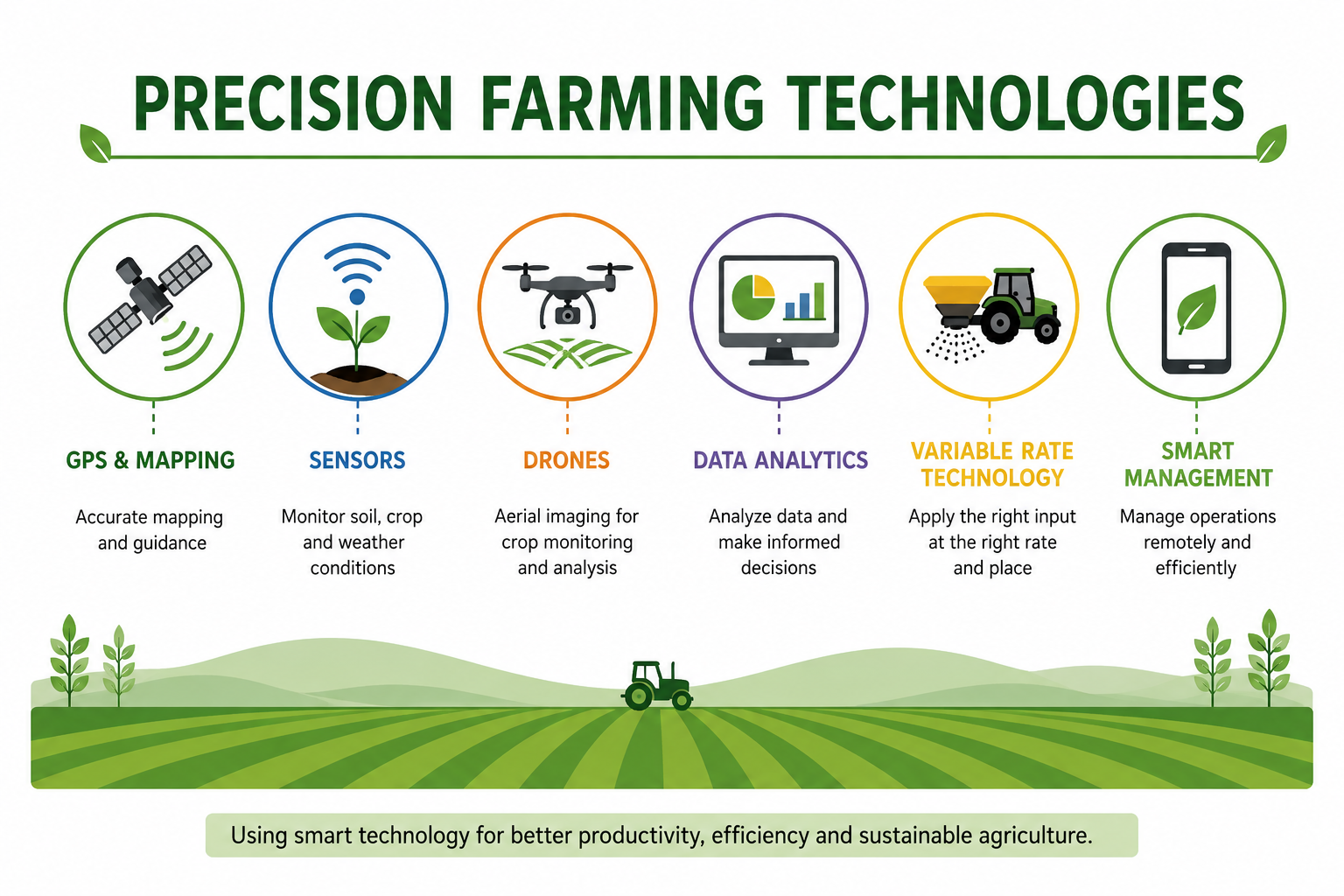
Precision Farming Technologies
Precision farming technologies are transforming modern agriculture by introducing advanced tools and data-driven methods to improve productivity, efficiency, and sustainability. Traditional farming methods often rely on uniform practices across entire fields, which can lead to resource wastage and inconsistent crop performance. Precision farming uses technology to analyze field conditions in real time and apply targeted solutions that optimize agricultural operations.
As the demand for food continues to grow globally, farmers face challenges such as limited resources, climate changes, labor shortages, and increasing production costs. Precision farming technologies provide intelligent solutions that help farmers maximize yield while reducing waste and environmental impact. By integrating automation, sensors, GPS systems, data analytics, and connected devices, precision agriculture enables better decision-making and improved farm management.
Understanding Precision Farming Technologies
Precision farming, also known as precision agriculture or smart farming, involves using advanced technologies to monitor, measure, and manage crop production more accurately. The goal is to ensure that crops receive the right amount of water, fertilizers, pesticides, and nutrients at the right time and location.
Rather than treating an entire field uniformly, precision farming focuses on identifying variations within fields and managing them individually. This approach allows farmers to optimize inputs and increase overall agricultural efficiency.
Modern precision farming combines several technologies that work together to create a connected farming ecosystem.
Key Technologies Used in Precision Farming
GPS Technology
Global Positioning System (GPS) technology plays an important role in precision farming. GPS enables accurate mapping and positioning of agricultural equipment and field locations.
GPS technology supports:
-
Field mapping
-
Vehicle guidance
-
Precision planting
-
Soil sampling
-
Equipment tracking
Farmers can use GPS-guided machinery to reduce overlap during planting and spraying operations, minimizing resource waste and improving efficiency.
Sensors and Monitoring Systems
Sensors are essential components in precision agriculture. These devices collect real-time information about soil conditions, crop health, moisture levels, temperature, and environmental changes.
Common agricultural sensors include:
-
Soil moisture sensors
-
Temperature sensors
-
Nutrient sensors
-
Weather sensors
-
Crop health sensors
The collected data helps farmers understand field conditions and make informed decisions regarding irrigation, fertilization, and crop management.
Internet of Things (IoT)
The Internet of Things has introduced connectivity into agriculture by allowing equipment and devices to communicate and exchange information.
IoT-based systems help farmers:
-
Monitor field conditions remotely
-
Track equipment performance
-
Manage irrigation systems
-
Collect real-time farm data
-
Improve decision-making processes
Connected devices provide continuous updates and allow farmers to monitor operations using mobile applications and cloud platforms.
Drones and Aerial Imaging
Agricultural drones have become valuable tools in precision farming. Equipped with cameras and imaging systems, drones can capture detailed information about fields and crops.
Drones are commonly used for:
-
Crop monitoring
-
Disease detection
-
Field analysis
-
Plant health assessment
-
Yield prediction
Aerial images provide a clear view of crop conditions, helping farmers identify problems before they spread across the field.
Data Analytics and Artificial Intelligence
Precision farming generates large amounts of agricultural data. Data analytics and artificial intelligence convert this information into meaningful insights that support decision-making.
AI-based systems can analyze:
-
Weather patterns
-
Soil conditions
-
Crop performance
-
Disease risks
-
Yield trends
Predictive analysis allows farmers to make proactive decisions that improve productivity and reduce risks.
Variable Rate Technology (VRT)
Variable Rate Technology allows farmers to apply inputs such as fertilizers, pesticides, and seeds at different rates across a field based on specific requirements.
Benefits of VRT include:
-
Reduced resource waste
-
Improved crop health
-
Lower operating costs
-
Increased yield potential
-
Better environmental management
Instead of applying the same quantity everywhere, VRT ensures resources are used efficiently.
Benefits of Precision Farming Technologies
Improved Crop Productivity
Precision farming technologies help farmers understand crop requirements more accurately. By delivering resources where needed, crop performance improves significantly.
Targeted management practices support healthier plants and higher yields.
Efficient Resource Utilization
Traditional farming methods can result in overuse of fertilizers, water, and chemicals. Precision agriculture reduces unnecessary applications and optimizes resource usage.
This leads to:
-
Reduced input costs
-
Better water management
-
Lower chemical consumption
-
Improved operational efficiency
Cost Reduction
Automation and data-driven decisions help minimize labor requirements and operational expenses. Reduced resource usage and optimized processes lower overall production costs.
Better Environmental Sustainability
Excessive use of fertilizers and pesticides can negatively affect the environment. Precision farming minimizes waste and reduces environmental impact.
Sustainable farming practices contribute to:
-
Lower soil degradation
-
Reduced pollution
-
Efficient water conservation
-
Improved ecosystem protection
Improved Decision-Making
Real-time information enables farmers to make more accurate decisions regarding planting schedules, irrigation, crop health management, and harvesting operations.
Data-driven decisions reduce uncertainty and improve productivity.
Applications of Precision Farming Technologies
Precision farming technologies support a wide range of agricultural activities.
Crop Monitoring
Continuous monitoring helps detect early signs of diseases, nutrient deficiencies, and pest infestations.
Irrigation Management
Smart irrigation systems use sensor data to deliver the right amount of water to crops.
Soil Analysis
Soil testing technologies provide information about nutrient levels and field conditions.
Harvest Optimization
Predictive analytics helps determine the best harvesting time for maximum crop quality and yield.
Equipment Management
Connected machinery allows farmers to track equipment performance and schedule maintenance efficiently.
Future of Precision Farming Technologies
The future of agriculture is becoming increasingly intelligent and connected. Emerging technologies such as machine learning, robotics, autonomous tractors, and advanced analytics are expected to further transform farming operations.
As precision farming technologies continue evolving, farmers will gain greater control over agricultural processes and improve productivity with fewer resources. Integration of digital technologies will help meet growing food demands while supporting environmental sustainability.
Conclusion
Precision farming technologies are revolutionizing agriculture by combining data, automation, and intelligent systems to optimize farming practices. From GPS and sensors to drones and artificial intelligence, these technologies provide farmers with powerful tools for improving productivity, reducing costs, and supporting sustainable agriculture.
As modern farming continues to evolve, precision agriculture will remain a critical solution for achieving efficient, reliable, and environmentally responsible food production.
Improve accuracy for writing and career work
Upgrade to Plus and use the latest Thinking model to refine writing, learning, applications, and career work.

 عربي
عربي