


 SPARK Website
How is the Automotive Ignition Coil Market Evolving Globally?
Automotive Ignition Coil Market Research Report
The Automotive Ignition Coil Market is witnessing steady growth driven by increasing global vehicle production, rising demand for fuel-efficient ignition systems, and continuous improvements in internal combustion engine technologies. According to Redline Pulse, ignition coils remain a critical component in ICE vehicles as they convert low battery voltage into high voltage required for spark generation and efficient combustion performance.
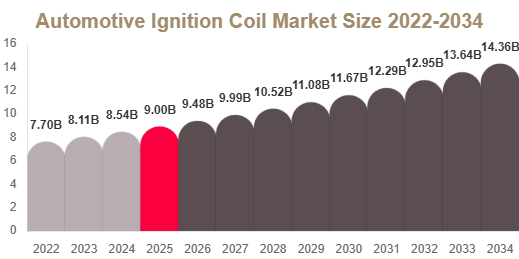
The Automotive Ignition Coil Market size was valued at USD 8.92 billion in 2025 and is projected to reach USD 9.48 billion in 2026. The market is expected to reach USD 14.36 billion by 2034, expanding at a CAGR of 5.33% during 2025–2034.
Report link : https://www.redlinepulse.com/report/automotive-ignition-coil-market
Buy Now Link : https://www.redlinepulse.com/report/automotive-ignition-coil-market/buy-now
Report Sample Link : https://www.redlinepulse.com/report/automotive-ignition-coil-market/request-sample
Market Overview and Growth Drivers
Rising Global Vehicle Production
One of the major drivers of the Automotive Ignition Coil Market is the continuous increase in global vehicle production, especially in emerging economies such as India, China, Brazil, and Mexico. Higher vehicle ownership directly increases demand for ignition coil systems across passenger and commercial vehicles.
Increasing Focus on Fuel Efficiency and Emission Control
Automotive manufacturers are under pressure to improve engine efficiency and reduce emissions. Advanced ignition coil systems, especially coil-on-plug and pencil coils, help optimize combustion, reduce fuel consumption, and improve overall engine performance.
Expanding Automotive Aftermarket Demand
As the global vehicle fleet grows and ages, replacement demand for ignition coils is increasing significantly. The aftermarket segment plays a crucial role in sustaining long-term market growth due to regular wear and maintenance requirements.
Continued Dominance of ICE Vehicles
Despite the growth of electric vehicles, internal combustion engine vehicles still dominate global transportation. This ensures continued demand for ignition coil systems across both OEM and aftermarket channels.
Market Challenges
Rising Electric Vehicle Adoption
The shift toward electric vehicles is a major long-term restraint for the Automotive Ignition Coil Market, as EVs do not require ignition systems. Increasing EV penetration may gradually reduce demand for ICE components.
Technological Complexity
Modern ignition systems such as coil-on-plug require high precision, electronic integration, and advanced materials, increasing manufacturing complexity and production costs.
Cost Pressure on Manufacturers
Automotive OEMs continuously demand cost optimization, creating pressure on suppliers to deliver high-performance ignition systems at competitive prices.
Segments Analysis of Automotive Ignition Coil Market
By Type
Coil-on-plug systems dominate the market with a 42.36% share in 2025 due to higher efficiency, improved ignition accuracy, and reduced energy loss. These systems are widely used in modern ICE vehicles.
Conventional ignition coils and distributor-based systems are gradually declining but still used in older vehicle models and cost-sensitive markets.
Pencil coils are the fastest-growing segment due to compact design, better heat resistance, and suitability for modern turbocharged and hybrid engines.
By Vehicle Type
Passenger vehicles hold the largest share of 67.21% in 2025 due to high production volumes and widespread use of ICE engines in global markets.
Light commercial vehicles are growing steadily due to expansion in logistics, e-commerce, and transportation services.
Heavy commercial vehicles require durable ignition systems for high-load operations and long operational cycles.
By Fuel Type
Gasoline vehicles dominate the market with a 74.18% share due to their widespread usage in passenger cars and light vehicles.
Diesel vehicles contribute to steady demand in commercial applications.
Hybrid vehicles are the fastest-growing segment as they combine ICE systems with electrification, requiring efficient ignition coil technologies.
Regional Analysis
Asia Pacific is the fastest-growing region due to rising vehicle production, industrial expansion, and strong automotive manufacturing in China and India.
North America remains strong due to a large automotive aftermarket and high vehicle ownership levels.
Europe is driven by strict emission regulations and adoption of advanced engine technologies in premium vehicles.
Latin America shows steady growth supported by rising vehicle parc and aftermarket demand.
Middle East & Africa is expanding due to increasing vehicle imports and growing transportation needs.
Competitive Landscape
The Automotive Ignition Coil Market is moderately competitive, with companies focusing on improving ignition efficiency, durability, and thermal performance. Key players are also investing in advanced coil technologies compatible with turbocharged and direct-injection engines.
- Robert Bosch GmbH
Bosch is a leading global supplier of ignition systems with strong OEM partnerships and continuous innovation in high-energy ignition coil technologies. - Denso Corporation
Denso focuses on advanced ignition systems designed to improve fuel efficiency, reduce emissions, and enhance engine performance. - NGK Spark Plug Co., Ltd.
NGK specializes in ignition components with strong expertise in spark and ignition coil technologies for global automotive markets. - Delphi Technologies (BorgWarner)
Delphi provides advanced ignition solutions designed for modern engine architectures and improved combustion efficiency. - Valeo SA
Valeo develops efficient ignition systems integrated with modern automotive engine technologies.
Market Outlook
The Automotive Ignition Coil Market is expected to maintain steady growth through 2034, supported by continued ICE vehicle demand, rising aftermarket replacement needs, and advancements in ignition system technology. Although EV adoption presents a challenge, ongoing improvements in fuel efficiency and engine optimization will sustain market expansion.

 عربي
عربي