


 SPARK Website
Trash Bag Market to Reach USD 18.2 Billion by 2036 | Driven by Urbanization and Increasing Municipal Solid Waste
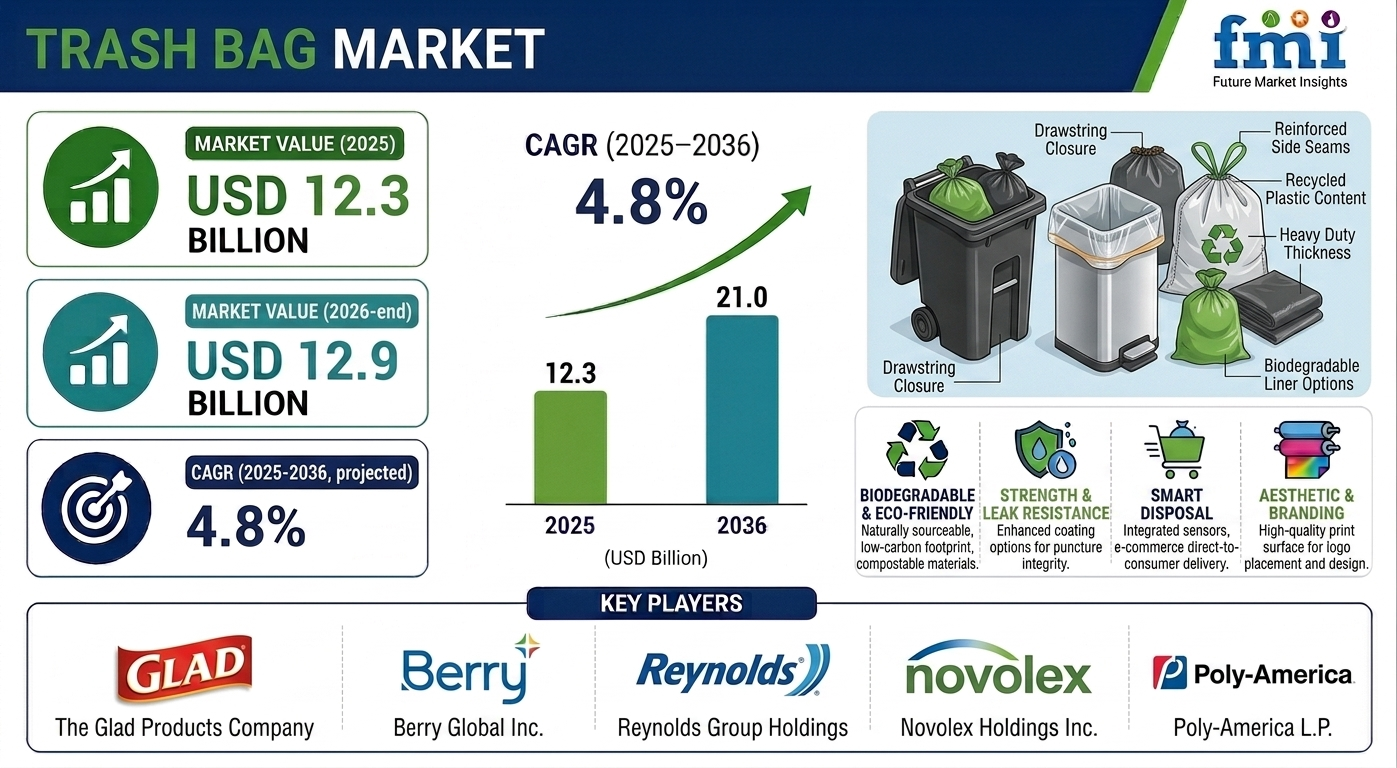
According to Future Market Insights (FMI), The global trash bag market is entering a new phase of industrial and consumer evolution, driven by urbanization, stricter waste-management standards, premiumization trends, and the growing integration of sustainability into everyday disposal systems. Once viewed largely as a low-margin commodity segment, trash bags are increasingly becoming part of broader waste-management infrastructure tied to sanitation, odor control, smart-city initiatives, and environmental compliance.
The global trash bag market is expected to grow from USD 12.3 billion in 2025 to USD 19.7 billion by 2035, registering a CAGR of 4.8%. While the category remains heavily volume-driven, long-term value creation is increasingly shifting toward premium, specialized, and technology-enabled waste containment solutions. The market’s next decade will likely be defined less by simple plastic bag consumption and more by how manufacturers respond to evolving consumer expectations around convenience, hygiene, sustainability, and integrated waste tracking.
Quick Stats: Trash Bag Market
- Market Value (2025): USD 12.3 billion
- Projected Market Value (2035): USD 19.7 billion
- Forecast CAGR (2025–2035): 4.8%
- Leading Bag Type: Drawstring Trash Bags
- Primary Application: Residential Waste Management
- Fastest-Growth Regions: East Asia, South Asia, North America
- Key Companies: The Glad Products Company, Berry Global, Reynolds Group Holdings, Novolex, Poly-America
Get Detailed Market Forecasts, Competitive Benchmarking, and Pricing Trends: https://www.futuremarketinsights.com/reports/sample/rep-gb-18861
Market Growth Will Be Driven by Urbanization and Waste Generation
The expansion from USD 12.3 billion to USD 19.7 billion over the next decade reflects broader demographic and infrastructure trends.
The strongest demand drivers include:
- Rapid urban population growth
- Rising household waste generation
- Expansion of commercial real estate
- Construction activity
- Growth in food delivery and e-commerce packaging waste
Urbanization is especially important because dense residential environments create higher demand for:
- Durable bags
- Odor-control systems
- Reliable closure mechanisms
- Frequent waste disposal
The trend is particularly visible across emerging economies where urban waste infrastructure is scaling rapidly.
Drawstring Bags Continue to Dominate the Market
Drawstring Bags Hold 41% Market Share
Drawstring trash bags remain the market leader because they combine:
- Convenience
- Improved sealing
- Easier transport
- Reduced spillage risk
Their dominance reflects consumer preference for products that simplify waste handling while improving sanitation.
Manufacturers continue investing in:
- Stronger drawstring integration
- Improved weight distribution
- Stretch resistance
- Enhanced polymer engineering
Drawstring systems are increasingly positioned as the “default premium format” across residential and retail segments.
Specialty Bags Are Emerging as a Major Profit Pool
Although standard residential bags still dominate volume sales, higher-margin categories are expanding faster.
Key premium segments include:
- Odor-blocking bags
- Compostable bags
- Antimicrobial bags
- Scented products
- Smart waste-tracking bags
Over the next 3–5 years, smart waste bags integrated with RFID and IoT tracking systems could represent one of the industry’s most significant new revenue opportunities.
These products are expected to gain traction in:
- Smart-city programs
- Commercial facilities
- Healthcare waste management
- Industrial waste tracking systems
The industry is gradually moving toward waste-containment products that can integrate into broader digital waste-management ecosystems.
Sustainability Is Reshaping Product Development
Perhaps the most important structural challenge facing the industry is environmental pressure.
Traditional polyethylene trash bags face growing scrutiny because of:
- Plastic waste concerns
- Landfill accumulation
- Single-use packaging regulations
- Circular economy mandates
As a result, manufacturers are accelerating investments in:
- Compostable materials
- Biodegradable polymers
- Post-consumer recycled content
- Plant-based resin technologies
This transition is creating both risk and opportunity.
While sustainability initiatives may increase manufacturing complexity and material costs, they also create premium product categories with stronger pricing power.
Compostable and Recycled Bags Gain Strategic Importance
The strongest growth in sustainable packaging is expected in:
- Certified compostable bags
- Recycled-polymer trash bags
- Carbon-neutral production systems
Commercial buyers, municipalities, and environmentally conscious consumers increasingly demand products aligned with:
- ESG targets
- Waste-diversion goals
- Regulatory compliance frameworks
Manufacturers that can provide:
- Documented sustainability certifications
- Reliable performance standards
- Scalable production capacity
are likely to gain competitive advantage as regulations tighten globally.
Commercial and Industrial Demand Remains Strong
Beyond residential consumption, commercial and industrial sectors continue generating substantial demand.
Commercial Offices
Office buildings increasingly require:
- Standardized waste-management systems
- High-volume procurement
- Cost-efficient disposal products
Construction and Industrial Applications
Heavy-duty contractor bags remain critical across:
- Construction sites
- Manufacturing facilities
- Industrial cleanup operations
These applications prioritize:
- Tear resistance
- Load capacity
- Puncture durability
- Leak prevention
Contractor bags are expected to remain one of the market’s strongest industrial profit segments through 2035.
Smart Waste Management Is Becoming a Long-Term Industry Theme
The industry is beginning to intersect with broader smart-city infrastructure initiatives.
Emerging innovations include:
- RFID-enabled waste bags
- Waste-volume tracking
- Automated disposal monitoring
- IoT-integrated waste systems
These technologies may allow:
- Municipal waste optimization
- Better recycling management
- Commercial waste tracking
- Improved disposal analytics
While still early-stage, smart waste integration represents a potentially important long-term value driver for the market.
Speak to Analyst: Customize insights for your Business Strategy: https://www.futuremarketinsights.com/customization-available/rep-gb-18861

 عربي
عربي