


 SPARK Website
Monorail Market Size, Share, and Forecast
The monorail market in North America is projected to experience steady growth during the forecast period, supported by increasing urbanization and transportation modernization efforts. The United States accounts for the largest share of the regional market due to ongoing infrastructure investments and growing demand for sustainable transit systems. Market expansion is expected to be driven by new project developments, technology advancements, and government support for environmentally friendly transportation solutions.
The monorail market demand for reliable mass transit solutions continues to rise as metropolitan areas experience population growth and expanding transportation requirements. Monorail systems provide a practical alternative to traditional rail and metro networks, particularly in cities where land constraints and construction challenges limit infrastructure expansion. Their ability to operate on elevated tracks helps reduce traffic congestion while improving connectivity between residential, commercial, and industrial areas.
Download Sample Report – https://www.theinsightpartners.com/Sample/TIPAT00002207
Market Overview
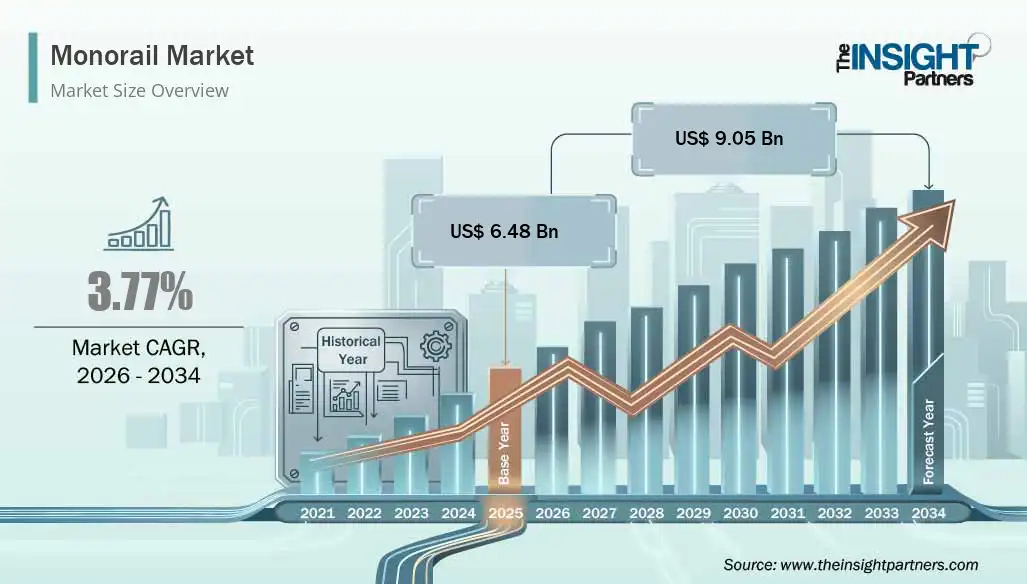
The global monorail market size is projected to reach US$ 9.05 billion by 2034 from US$ 6.48 billion in 2025. The market is anticipated to register a CAGR of 3.77% during the forecast period 2026-2034.
The market's growth is supported by increasing urban population density, government investments in public transportation, and rising demand for efficient transit solutions. As cities continue to address mobility challenges and environmental concerns, monorail systems are expected to play an important role in future transportation networks.
Key Market Drivers
Rapid Urbanization and Population Growth
One of the primary drivers of the monorail market is rapid urbanization. Cities across the globe are experiencing substantial population growth, placing significant pressure on existing transportation infrastructure. Traditional road networks often struggle to accommodate increasing numbers of commuters, leading to severe congestion and longer travel times.
Monorail systems provide an effective solution by offering high-capacity transportation without requiring extensive land acquisition. Their elevated design allows cities to maximize available space while improving mobility and reducing traffic bottlenecks.
Increasing Traffic Congestion in Urban Areas
Traffic congestion has become a major challenge for urban planners worldwide. Growing vehicle ownership and limited road expansion opportunities have intensified transportation issues in many metropolitan regions.
Monorails help alleviate congestion by providing dedicated transit corridors that operate independently of road traffic. This enables faster travel times, improved reliability, and enhanced commuter experiences, making monorail systems an attractive option for urban transportation authorities.
Government Investments in Public Transportation
Governments are increasingly investing in modern public transportation infrastructure to support sustainable economic growth and improve urban mobility. Public transit projects are receiving significant funding as policymakers seek to reduce congestion, lower emissions, and enhance transportation accessibility.
Monorail systems are often included in urban transportation master plans due to their operational efficiency and lower environmental impact. These government-led initiatives are expected to remain a major growth driver throughout the forecast period.
Growing Focus on Sustainable Mobility
Environmental sustainability has become a key consideration in transportation planning. Cities are seeking alternatives to private vehicle usage to reduce greenhouse gas emissions and improve air quality.
Monorails offer an environmentally friendly transportation solution by supporting electric-powered operations and reducing dependence on fossil fuels. Their ability to transport large numbers of passengers efficiently contributes to broader sustainability objectives and supports climate action goals.
Smart City Development Initiatives
The emergence of smart city projects is creating new opportunities for monorail deployment. Smart cities prioritize integrated transportation systems that enhance connectivity, efficiency, and sustainability.
Monorails are increasingly being incorporated into smart mobility frameworks due to their compatibility with digital technologies, intelligent traffic management systems, and modern urban planning strategies. This trend is expected to support long-term market growth.
Emerging Market Trends
Adoption of Driverless Monorail Systems
Automation is becoming a significant trend within the monorail industry. Advanced signaling systems, artificial intelligence, and automated train operations are enabling the deployment of driverless monorail systems.
These technologies improve operational efficiency, reduce labor costs, and enhance safety. As automation capabilities continue to advance, more transit authorities are expected to adopt autonomous monorail solutions.
Integration with Multimodal Transportation Networks
Cities are increasingly focusing on seamless transportation experiences by integrating multiple transit modes. Monorails are being connected with metro systems, buses, airports, and regional rail networks to improve accessibility and passenger convenience.
This integrated approach supports efficient urban mobility and encourages greater public transportation usage.
Advancements in Energy-Efficient Technologies
Manufacturers are developing energy-efficient monorail systems that incorporate regenerative braking, lightweight materials, and advanced propulsion technologies. These innovations help reduce operating costs while supporting environmental sustainability goals.
The growing emphasis on energy efficiency is expected to influence future monorail system designs and investment decisions.
Competitive Landscape
The monorail market is characterized by the presence of global transportation technology providers and infrastructure development companies. Market participants are focusing on innovation, project execution capabilities, and long-term service agreements to strengthen their competitive positions.
Strategic collaborations between technology providers, construction firms, and government agencies are supporting the development of new monorail projects worldwide. Investments in research and development are also driving advancements in system performance, safety, and operational efficiency.
Top Players in the Monorail Market
- Hitachi Rail Ltd.
- Alstom SA
- Siemens Mobility GmbH
- CRRC Corporation Limited
- Bombardier Transportation
- BYD Company Ltd.
- Intamin Transportation Ltd.
- Mitsubishi Heavy Industries, Ltd.
- Scomi Engineering Bhd
- Thales Group
These companies continue to invest in advanced transit technologies and global infrastructure projects to strengthen their market presence and meet growing demand for urban transportation solutions.
Future Outlook
The future of the monorail market remains positive as cities continue to invest in sustainable transportation infrastructure. Rapid urbanization, rising population density, and increasing environmental awareness are expected to create significant opportunities for market expansion.
Technological advancements in automation, digital connectivity, and energy-efficient operations will further enhance the attractiveness of monorail systems. Emerging economies are likely to remain major growth centers due to extensive infrastructure development and urban transit modernization programs.
Conclusion
The global monorail market is poised for steady growth through 2034, driven by urbanization, government transportation investments, traffic congestion challenges, and growing demand for sustainable mobility solutions. The market is projected to grow from US$ 6.48 billion in 2025 to US$ 9.05 billion by 2034, registering a CAGR of 3.77% during the forecast period. As cities continue to prioritize efficient and environmentally responsible transportation systems, monorails will play an increasingly important role in shaping the future of urban mobility.
Contact Information -
Email: sales@theinsightpartners.com
Phone: +1-646-491-9876
Also Available in :

 عربي
عربي